28 May 2011

This is Tahrir Square... yesterday


Yes. It is the afternoon of 27 May 2011... And Cairo's Tahrir Square is filling up with thousands of Egyptians in what organisers called a "Second Revolution".

Why? Because "people do not see any change," according to one volunteer. "The only change we see is that the Mubarak metro station has been changed to the Martyrs station."

Meanwhile packs of international financiers are licking their chops... On Thursday, 26 May, the International Monetary Fund (IMF) estimated in a report to the G8, that "external financing" needs of oil-importing countries in the Middle East and North Africa will exceed $160 billion over the next three years - and that donor countries must step in to help.

The IMF has announced it is ready to lend about $35 billion to "stabilise" economies of countries such as Egypt, Jordan, Lebanon, Morocco, Tunisia, and Syria who are facing surging food and energy prices.

The same week, the World Bank said they want “to help the people there and seize the opportunities of historic change to modernize their economies and build more open and inclusive societies.”

Apparently, they want nothing to "undermine the transition to democracy".

Aw, how considerate of them...

So when is the Nile scheduled to be privatised? And are the pyramids going as a package deal?

26 May 2011

Why is India's Department of Biotechnology funding Monsanto's GMO development?

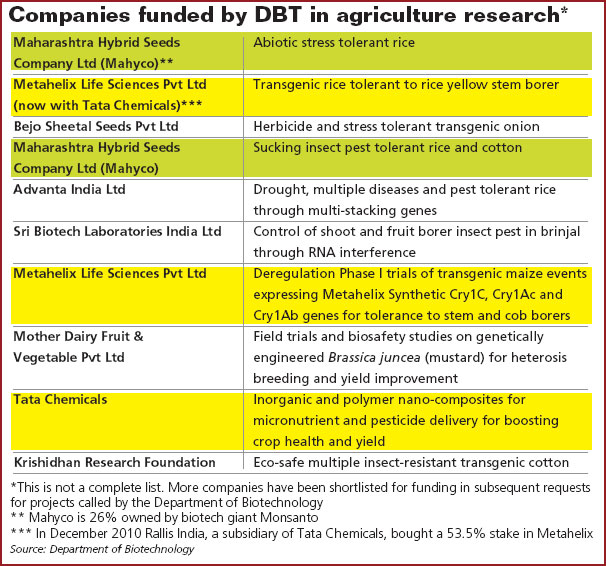
For the life of me, I can't think of a good reason why the public sector Department of Biotechnology (DBT) is funding 2 GMO development projects by Mahyco (26% owned by Monsanto) to the tune of Rs 2 crores each.

Then again, why does a company whose revenue in 2009-10 crossed Rs 220 crores require this funding? Well, the reason is that the funding also comes with knowledge transfer!

Under the Biotechnology Industry Partnership Programme (BIPP) Monsanto - er, Mahyco can access the "the vast expertise on rice available with the public sector research institutions". This expertise has been built up over several decades of partnership with farmers, and paid for by Indian taxpayers.

But who owns the technology that Monsanto develops using this expertise? Well, Monsanto, of course. The Indian public will manage to get back the paltry fund amount in the form of a 5% "royalty"! Now that's a really fine deal for the country.

And Monsanto isn't the only beneficiary.


Here's how the "partnership" has panned out for the Indian farming community so far...


And for a glimpse of the future, let's hear it from people who really know the "benefits" of dealing with Monsanto...

24 May 2011

Engineers vs. Snake Oil Salesmen

I was sent this interesting piece of news today (Thanks, Anusha).

It seems...

"Toyota has teamed up with salesforce.com to create Toyota Friend, a private social network for owners of Toyota cars.

The network will be accessible through PCs, tablets and smartphones, giving Toyota customers the ability to connect with their dealerships, cars and Toyota itself. For example, your car could send you an alert when its battery needs recharging, and you would be able to connect to your dealership to get maintenance tips and service information.

Toyota Friend will primarily be a private network for Toyota car owners, but customers will be able to connect and expand the experience through public social networks such as Facebook and Twitter.

On the financial side, Salesforce.com will invest 223 million yen ($2.7 million) and Toyota Motor Company will invest 442 million yen ($5.4 million) in Toyota Media Service, which oversees Toyota’s global cloud platform development. Microsoft, which entered a strategic partnership with TMC in April, aiming to bring internet services to Toyota vehicles, will invest 350 million yen ($4.3 million) in the platform."

WTF!

Firstly, aren’t social media devices totally incompatible with Toyota products' core use: Driving?

Secondly, according to Mr Toyoda, “Despite negative factors such as a rapid rise in the yen and the earthquake, our profit sharply rose, thanks to massive cost-cutting and sales efforts.”

Let's decrypt that statement: Toyota is skimping on production and quality (i.e. cost-cutting), while spending more on marketing (i.e. sales efforts). So possibly, they now have a higher profit ‘margin’ with an inferior product!

Toyota’s recent ‘recall’ fiasco affected 14 million vehicles worldwide and battered the company’s reputation for quality. But hey, investors care more about Q-on-Q profits than reputation – so, $12.4 million spent on a marketing gimmick makes more sense than improving the actual product!

It makes one wonder though, if Mr Toyoda (who family name is at stake) doesn't see the pitfalls, why would ANY company management care for a sustainable long-term Brand Strategy?

Are account books blinkering the vision of corporate decision-makers? Is the focus on numbers leading into a unacceptably myopic view?

I posted once before on how inordinate focus on short-term profits can erode equity and actually stand in the way of long-term growth.

To me it seems that somehow, across the corporate world - up and down the line - the wrong set of behaviours are being incentiviced.

23 May 2011

Who decides what you see on the Internet?

Well, for one thing - it isn't you.

As you will find out in the following video, information is not only filtered at several levels, but in so many different ways as well... And the worst worrying aspect is that you never really know what is being kept from you!

One manifestation of this is the Splinternet - which is, to use a metaphor, ranchers (service providers) corralling steers (users) into vast pastures (Internet and mobile platforms) in the Wild West. The difference is that the world outside the fence is invisible!

This trend is not going to be rolled back as 'users' and their 'profiles' are the only real assets that can be monetised by companies like Apple, Google, Yahoo, and their ilk. Also the more detailed the user profile, the more valuable it is.

The web as we know it has changed. And most of us don't even know it.

21 May 2011

India to hand out 1 billion Internet 'kill switches'

I had posted earlier about the absurdity of the new, degenerate IT (Information Technology) Act passed by the Government of India.

Well, looks like it's actually much worse.

Now anyone can censor anyone... Internet platforms (like Google and Yahoo) will have a hefty hardcover volume of the Indian Penal Code (IPC) thrown at them if they don't yank, within 36 hours, posted content that has been construed as 'objectionable' or 'disparaging' by literally any one of the billion-plus Indians with an individual opinion or an excitable disposition.

But wait! That's just the beginning... There are now what can only be described as 'bizarre' conditions for the ubiquitous Indian cyber cafe too.

According to an article on the Outlook India website the new rules regarding cyber cafes include such draconian directives as the layout and arrangement of furniture!

In addition, "the new guidelines mandate that cyber cafes keep a photo ID record of all users apart from maintaining usage data of individuals — including logs of all websites surfed by them — for one year." This, mind you, inspite of mildly annoying requirements that already exist, like stating your name, mobile number and browsing time. Many governments already view their citizens as potential criminals who must have their every activity open for investigated - whenever the "authorities" demand it.

Ladies and gentlemen, what you are witnessing is Big Brother slamming your freedom to express yourself onto the pavement, and proceeding to kick its teeth in!

However, the legal rape of opinion does have the wholehearted support of a certained shady ponytailed B-school professor-cum-salesman. But he's got good reason... I wonder if Sachin Pilot has one.

Sachin Pilot is the US-educated, baby-faced Minister of State for Communications and Information Technology. If one needs any more evidence of the increasingly disgusting hereditary nature of politics in India, and especially, New Delhi - this is a portfolio that was once held by his (late) father, Rajesh Pilot!

Oh! By the way, baby-face (who became India's youngest MP at 26) is under investigation in the multi-billion 2G spectrum sale scam. I wonder if the investigating agencies have a record of all the websites he visited. Or are such ridiculous laws not applicable if your daddy had a red light on his Amby?

17 May 2011

The spin doctor's prescription

Reuter's website has this brilliant piece of Orwellian Doublethink.

It pontificates that the Government of India (GoI) isn't helping the country's central bank, the Reserve Bank of India (RBI) in controlling runaway inflation. This is probably true given that while the RBI tries to tighen the fiscal belt, the GoI's single-minded focus (besides increasing the net worth of individual MPs) seems to be in maintaining the asinine 8% to 9% economic growth figure while the average Indian family frets over the price of rice, onion and cooking gas.

But the line that got my attention opines that the GoI's "foot-dragging on reform and foreign investment contributes towards keeping food price inflation high."

The highly imaginative author of the article however fails to mention exact how he or she arrived at the convoluted logic that higher profits for foreign investors means lower food price for Indians!

Even in actual fact, the GoI is shovelling financial deregulation through parliament; running through buckets of ink signing Free Trade Agreements (FTAs); and taking a crowbar to the backdoor of the nation's agro industry and food security. In short, India's present government seems hell-bent on burning down the economic defences of the nation.

The aim seems to be to throw the unprepared, unprotected Indian economy into bed with rapacious, unscrupulous multinational vampires. It will be a short, unsightly struggle - and then it'll all be over.

Still, it looks like one logically challenged economics pundit/journalist thinks the GoI has not done enough damage - not acquiesced quite enough.

Your move, Manmohan.

The news this morning...

A 20-year old Australian man fell from a 7-storied building in Brisbane while trying out a social media fad called "planking".


For those physically aged over 30 (and mentally, over 3), "planking" involves lying face down with arms to the sides, in a straight line - preferrably in an unusual public place; photographing it; and posting it on social media sites like Facebook and YouTube.

Apparently, it's to do with the pressures of today's online "reputation economy" on young people - or at least, that's the local Deputy Police Commissioner's take on the situation.

Anyway, the Brisbane Planking Association (I'm not kidding) vows that they will "absolutely not" stop. The Prime Minister of Australia, Julia Gillard, weighed in by urging plankers to learn the difference between "a harmless bit of fun ... and taking a risk with your life". And this morning, the incident was front-page news on the Reuters website.

Sad.

In other tragi-comic news from around the world... The United States has hit its debt limit. Congress will now have to decide whether (rather, when) it will raise the national debt ceiling (or the debt burden carried by citizens and taxpayers) from $14.3 trillion. This is only the 11th time they will be doing so since 2001.

Meanwhile the International Criminal Court's chief prosecutor has decided that the Libyian leader and his son must be punished for authorising the killing of civilians. Hours later, NATO jets continued to pound the capital city - presumably, causing no harm to civilians - er, I mean collateral damage.